I’ve been doing a Bible study recently with some wonderful ladies using a devotional by Nicky and Pippa Gumbel. One morning, Nicky shared something about forgiveness that stopped me in my tracks.
Now, I’ve talked about forgiveness before. I’ve written blogs, recorded podcasts, and shared why it matters so deeply. But this one line from Nicky shifted something in me:
“Forgiveness is more important than healing. But healing is not unimportant. Jesus does both.”
I had to pause. That truth hit differently.
I’d never really thought about forgiveness and healing in terms of priority. I knew Jesus does both—of course—but I hadn’t connected the order or the emphasis the way this devotional pointed out. And suddenly, it stirred something fresh in me about how powerful forgiveness truly is.
Think about it: you can experience healing in your physical body, but only forgiveness—real, heart-level forgiveness—can touch both the physical and the spiritual.
Isn’t that incredible?
Right after that study, I went digging a bit deeper. And the perfect example is found in Mark chapter 2—the story where four friends bring their paralyzed friend to Jesus.
They literally tear open a roof to lower him down. Their faith is huge. Their expectations are high. They came for healing…
but Jesus starts somewhere else.
When Jesus saw their faith, He said to the paralyzed man, “Son, your sins are forgiven.”
He didn’t begin with the physical.
He began with the spiritual—because that was the greater need.
Only afterward, in verses 11–12, does Jesus say:
“Get up, take your mat, and go home.”
And the man gets up and walks out in full view of everyone.
Forgiveness first.
Healing next.
This theme shows up again and again throughout Scripture.
Psalm 103 highlights it so clearly:
- He forgives all your sins
- and heals all your diseases
Forgiveness.
Then healing.
You can see this pattern in other passages as well:
- Acts 3:19: Repent… so that times of refreshing may come
- James 5:16: Confess your sins… so that you may be healed
- 1 John 1:9: If we confess our sins… He forgives us and cleanses us
Forgiveness is powerful.
Forgiveness is necessary.
And yet…
we cling to unforgiveness as if holding it tight will somehow fix something.
It won’t.
So let me gently ask you—because I’ve had to ask myself this too:
What unforgiveness are you holding onto?
What bitterness are you carrying that feels like protection… but is actually hurting you?
I’ll be honest: I am not always great at this. Forgiveness can be hard. People hurt us. People disappoint us. People betray our trust.
But here’s the flip side—
we have done the same to others.
Romans 3:10 reminds us: not one of us is righteous on our own.
We all fall short.
So if we long to be forgiven when we make mistakes, shouldn’t we be willing to extend that same grace to others?
Jesus forgave us far more than we will ever have to forgive anyone else.
Yet we hold onto offenses like armor—armor that weighs us down more than it protects us.
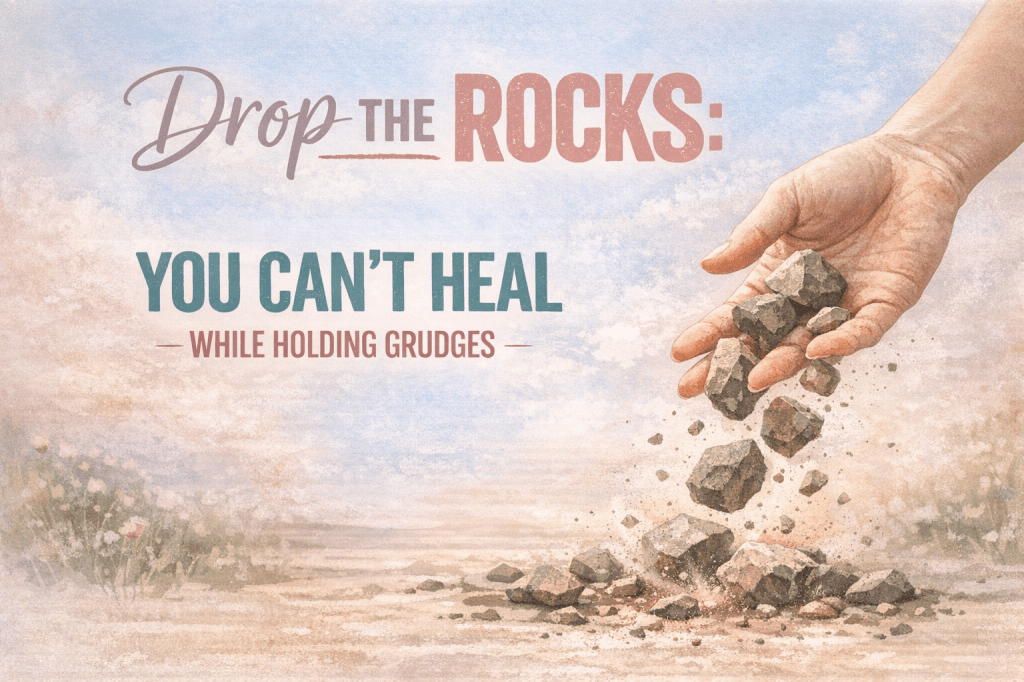
Whatever “rocks” you’re carrying—old hurts, unspoken frustrations, silent resentment—drop them.
Not because the person deserves it.
Not because it excuses what happened.
But because you deserve freedom.
Because forgiveness opens the door for healing—real, deep, spiritual healing.
Jesus starts with forgiveness for a reason.
And when we follow Him in that, healing finally has room to grow.
 angelaschmeling