
Did any of you see this post while doomlessly scrolling through Facebook awhile back?
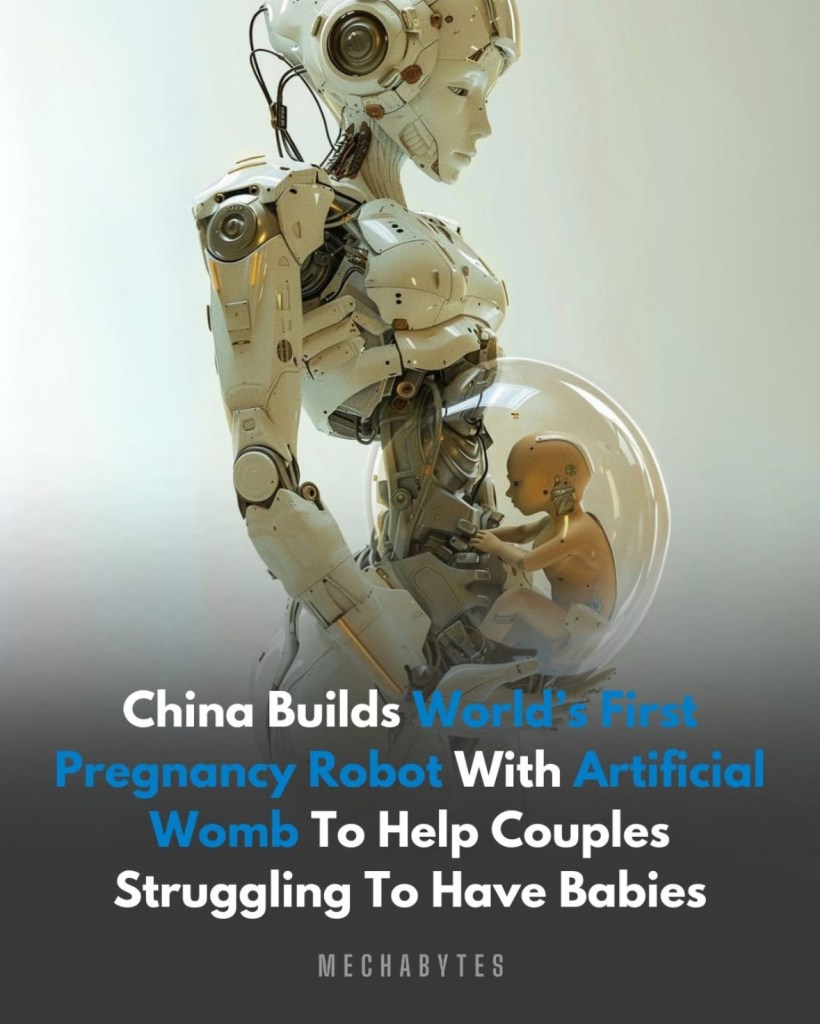
I’m not going to lie—my very first reaction was, are we entering the Matrix? Seriously. That’s exactly where my mind went. Rows of machines. Children growing in artificial environments. Tubes and wires and cold metal replacing something deeply human.
And then came the why.
Why would anyone think this is a good idea? With the advancements we already have in IVF, why would this even be necessary? If you don’t want to carry a child but want a baby, there are other options—surrogacy, adoption. There are so many children already in the system longing for a family. Instead of pouring energy into creating artificial wombs, why aren’t we working harder to improve the adoption process—making it smoother, safer, and more accessible?
Then my thoughts moved to the how.
How could this possibly work when pregnancy itself is so complex? And what would this do to a child—being grown inside a machine?
Having been pregnant three times, I cannot wrap my mind around how a child could grow in a robot and still develop the same connection to their mother. As I mentioned in my previous post, are we slowly replacing real connection with artificial substitutes? If a baby is grown without a mother’s body—without her heartbeat, her voice, her movement—does that sever something essential? Does it further distance us from the human interaction we so desperately need?
Since writing this, I’ve learned that the original story was false—the “pregnancy robot” itself does not currently exist. But that doesn’t dismiss the concern. With the pace of technological advancement, this idea is no longer far-fetched. Scientists have already been working on artificial wombs for premature babies, and even that raises serious ethical concerns in my mind.
The proposed design is unsettling: a bag of lab-created amniotic fluid filled with manufactured nutrients and growth factors. An umbilical cord attached to an external oxygenator acting as a stand-in for the placenta—regulating oxygen and carbon dioxide. The baby would be isolated from natural changes in light, sound, pressure, and temperature, as well as from germs.
Does that sound safe? Or natural?
Lab-made amniotic fluid. Artificial oxygenation. Complete environmental control. And we’re expected to believe this is somehow better for a baby? The justification is that similar technology has been “successful” in lambs, which is why researchers are considering human trials next.
Human trials.
Testing this on babies.
Ethically and morally, how is that acceptable?
They’re also developing artificial placentas—again, tested on animals, though not yet on humans. But we all know how this goes. With science, it’s rarely about whether it should be done—only whether it can be done, and then how far it can be pushed.
Ian Malcolm from Jurassic Park said it best:
“Your scientists were so preoccupied with whether or not they could, they didn’t stop to think if they should.”
Babies—our future—should never be guinea pigs. They shouldn’t be test subjects for experimental technology like this. It shouldn’t even be up for debate.
Dr. Harvey Klieman from Yale University put it this way:
“I think it’s interesting to think about the challenges because it helps us actually reflect on what is the beauty and miracle of a normal pregnancy.”
And he’s right.
Pregnancy is beautiful. It is miraculous. It is humanity partnering with the Creator to bring forth life.
Psalm 139:13–14 says,
“For you created my inmost being; you knit me together in my mother’s womb. I praise you because I am fearfully and wonderfully made; wonderful are your works!”
From a mother’s perspective, it doesn’t always feel beautiful in the moment. Pregnancy is exhausting, uncomfortable, and at times overwhelming. But when you pause and really take it in—the reality that a woman’s body is capable of growing another human being—it’s astonishing.
Feeling them move inside you.
Those first kicks.
Seeing your baby on the ultrasound.
Hearing that tiny heartbeat for the very first time.
It’s sacred. It’s humbling. It’s miraculous.
Replacing what is natural with something artificial—and assuming there will be no consequences—is dangerous. The repercussions would, not could, be harmful to the very children we claim to be trying to help. We are steadily distancing ourselves from real human connection and turning to artificial substitutes that will never truly satisfy or replace what God designed.
Let’s look at Psalm 139 again.
13 For you created my inmost being; you knit me together in my mother’s womb. 14 I praise you because I am fearfully and wonderfully made; your works are wonderful, I know that full well. 15 My frame was not hidden from you when I was made in the secret place, when I was woven together in the depths of the earth.16 Your eyes saw my unformed body; all the days ordained for me were written in your book before one of them came to be.17 How precious to me are your thoughts, God! How vast is the sum of them! 18 Were I to count them, they would outnumber the grains of sand— when I awake, I am still with you.
You can’t play God. No matter how advanced technology becomes, it will eventually break down—morally, ethically, or relationally—in more ways than we can even imagine. There is no comparison to His wisdom, His design, or His love as Creator. What God creates with intention and purpose cannot be replicated by human hands without consequence.
If you want to hear more on this study, you can read it here: https://www.livescience.com/health/fertility-pregnancy-birth/pregnancy-robot-from-china-is-fake-but-is-the-technology-behind-it-possible
 angelaschmeling